
SINGAPORE – Public officers should focus on possible solutions to problems and how to execute them, instead of being constrained by reasons why something cannot be done, said National Development Minister Chee Hong Tat on May 19.
He also encouraged civil and public servants to take calculated risks and try new ideas, as well as to be open to work with partners that offer a variety of viewpoints.
“When we are faced with a difficult problem, the first thing of course is, don’t be daunted – don’t let the problem overwhelm us,” he said at the third edition of the Public Service Science, Technology, and Engineering Festival.
“We must not get deterred because answers may not be readily available at the beginning… or worse, we self-impose constraints in our minds by assuming that someone else will not allow us to proceed.”
Speaking to about 1,200 government agency employees and students, he said: “We should stop assuming that we are just cogs in a machinery without agency and self-determination. That is not true.
“If the rules currently do not allow something to be done, and we assess that this initiative will benefit the country and our people, we can amend the rules. If the SOP (standard operating procedure) is no longer relevant and fit for purpose, we can change the SOP.”
Alternatively, said Mr Chee, deviation can be sought with proper authorisation, and additional budget or manpower can be requested.
He added that this is why he is a “firm advocate of doing pro-enterprise rules review” – something he said has been a priority for him in whichever ministry he works in.
Since Mr Chee took office as National Development Minister in May 2025, the ministry has rolled out several streamlined processes, such as for the hiring of foreign construction workers and the submission of building plans for the built environment sector, the procurement of research products, and in the criteria used to assess construction quality.
In his speech, Mr Chee also outlined three ways science, technology and engineering are a key part of his ministry’s work.
He highlighted efforts to build that are taller, deeper and smarter; to improve ways public services are planned, coordinated and delivered; and sustainability and climate resilience initiatives.
Mr Chee also encouraged public servants to “take calculated risks and try new ideas, and not be afraid of making some mistakes along the way”.
Acknowledging that this is easier said than done, he said: “As a system, we do need to be cautious which is understandable because we have a responsibility and accountability as public officers.”
But playing things too safe, said Mr Chee, prevents public servants from innovating.
He cited sandboxes and pilots as ways to “fail safely and to limit the downsides to the system as a whole”.
And when ideas have proven to work, they can be scaled up, he said.
Innovation is likelier to be achieved when different ideas come together, Mr Chee said, which is why it is important for public servants to be open to working with internal and external partners, “including those who may have different views from us”.
Public agencies should understand the perspectives of other stakeholders – especially those from the private and people sectors – so that measures can adequately address gaps and concerns on the ground.
The minister added that areas for improvement should be approached with honesty, and that even if things are working well, there is room to do better.
Hence, he said, public servants across all roles and at all levels of seniority should be sufficiently supported and comfortable enough to share ideas on how work can be done better.
He added that political office holders, permanent secretaries and chief executives of public agencies “have an important duty to provide an enabling organisational environment and an empowering culture that encourage our people to exhibit these qualities”.
At the festival, Mr Chee gave out prizes for the Science, Technology and Engineering Innovation Challenge, a contest organised to foster innovation in the public service, and encourage participating teams to develop impactful solutions that can be applied widely.
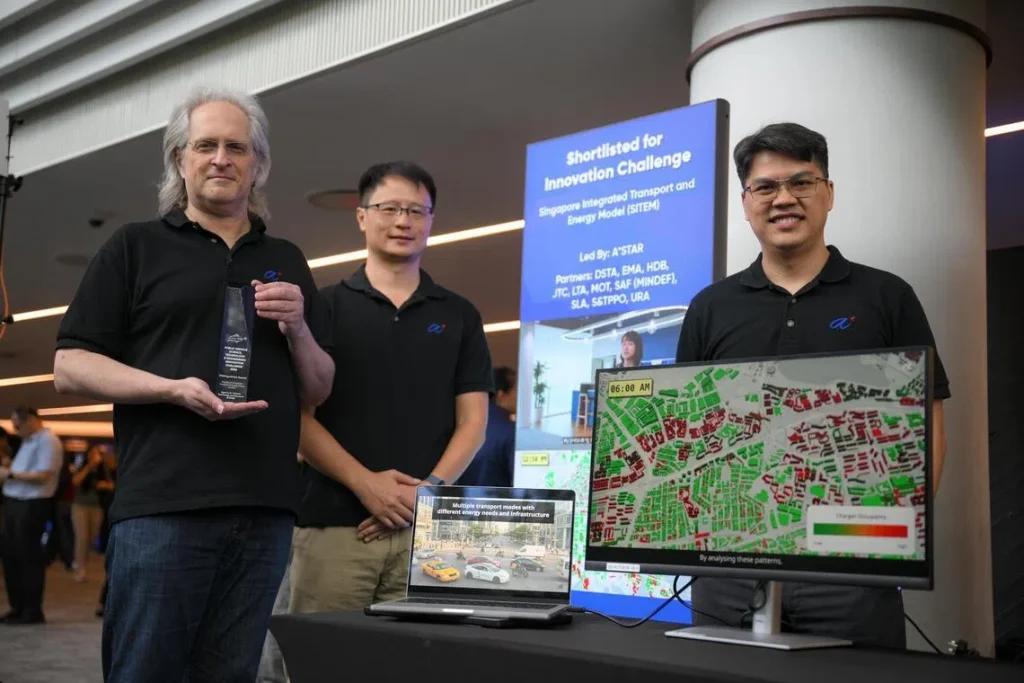
The distinguished award – the top recognition – went to a team from the Agency for Science, Technology and Research (A*STAR) for a system that supports electric vehicle EV infrastructure planning and policy evaluation.
(From left) Dr Ilya Farber, Dr Feng Ling and Dr Azfar Ramli from the Agency for Science, Technology and Research were part of the team behind an EV infrstructure planning model that picked up the top prize at the Science, Technology and Engineering Innovation Challenge.
ST PHOTO: MARK CHEONG
A*STAR senior principal scientist Azfar Ramli said that the system considers how to optimally deploy the 60,000 EV charging points that Singapore plans to install by 2030, and to understand and quantify the impact that this will have on the country’s power grid.
He added that besides data provided by agencies such as the Land Transport Authority (LTA) and the Energy Market Authority, the system also incorporates surveys done with EV users, such as private car owners, private hire vehicle drivers and goods vehicle drivers.
Dr Azfar said these drivers gave inputs on issues such as whether they prefer slow or fast chargers, whether where they typically park their vehicles – at home, in the office or enroute to the workplace – and what they do while waiting, such as where they go to eat.
Since its development, the model has been used by agencies such as LTA for planning purposes, such as to assess the adequacy of EV charger provisions.
The merit award went to a coastal water quality modelling project by the National Environment Agency, and a solar panel deployment system by a team from JTC Corporation that allows such systems to be set up in existing open areas, such as above canals.
(From left) Mr Cheng Shau Chuan, Mr Kevin Emanuel Suhartono, JTC Corporation Principal Engineer and Mr Zechariah Foong of JTC Corporation were part of the team that worked on the solar panel system.
ST PHOTO: MARK CHEONG
Mr Kevin Emanuel Suhartono, a principal engineer at JTC, said his team’s solution is lightweight and customisable: The height and width of the system’s support frames can be designed to fit the site conditions, and its modularity allows for replication at scale.
The team estimates that the system’s materials will cost 10 to 15 per cent less than conventional rigid structures, primarily because less steel is needed, and the construction process is simpler.
The festival is held once every two years and is organised by the Public Sector Science and Technology Policy and Plans Office, a department under the Prime Minister’s Office.
The post Public servants should actively seek solutions, and are not just ‘cogs in a machinery’: Chee Hong Tat appeared first on World Online.
