
Birthright citizenship is spelled out in the first line of the 14th Amendment to the Constitution: “All persons born or naturalized in the United States, and subject to the jurisdiction thereof, are citizens of the United States and of the State wherein they reside.”
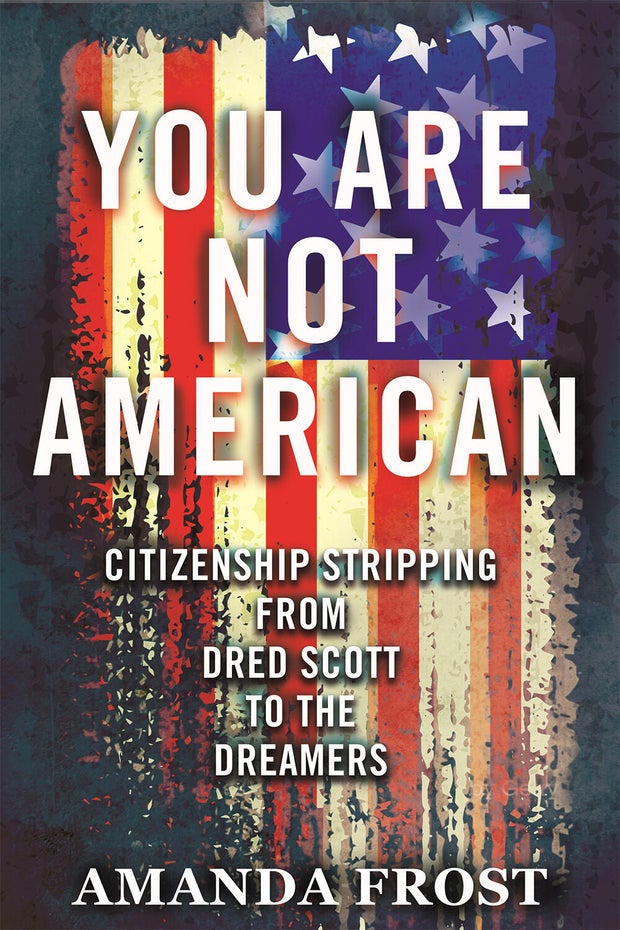
It means everyone born in the United States is automatically a U.S. citizen at birth, said University of Virginia law professor Amanda Frost, regardless of any aspect of their parentage or lineage, “with very narrow exceptions, being for the children of diplomats and invading occupying armies. Everyone else is a citizen at birth.”
Frost says there is no ambiguity about the Constitutional issue of this citizenship clause. But a poll by the Pew Research Center shows that the American public is pretty much evenly divided on whether citizenship should be granted at birth to the children of undocumented immigrants – 50 percent say yes, 49 percent say no.
In January 2025, President Trump issued an executive order stating that “the Fourteenth Amendment has never been interpreted to extend citizenship universally to everyone born within the United States.” The order would deny citizenship to the vast majority of children born to parents here illegally or temporarily. Roughly a quarter of a million children a year would be affected.
The executive order was blocked by a lower court, and is now before the Supreme Court.
The Supreme Court first weighed in on the issue of citizenship nearly 170 years ago, in what’s generally considered its most disgraceful opinion: the infamous decision in Dred Scott v. Sandford. “This is the decision from 1857, in which the Supreme Court said that no Black person, whether enslaved or free, could ever be a citizen of the United States,” said Frost. “Chief Justice Taney, who wrote that opinion, said, ‘If you don’t like it, you can amend the Constitution.’”
And that’s just what happened, after the Civil War in 1868, with the passage of the Fourteenth Amendment. “The Reconstruction Congress wanted to make it clear that all four million formerly-enslaved people were citizens of the United States,” said Frost. “They also addressed the fact that more and more immigrants were coming to U.S. shores, and they recognized that the children of immigrants would also be citizens.”
But 30 years later, the case of Wong Kim Ark came before the Supreme Court. Born in San Francisco to Chinese parents, Wong was denied reentry to the U.S. after a trip to China. Wong fought back, insisting on his rights as an American citizen.
“For me, Wong Kim Ark represents the common man,” said Norman Wong, a descendant of Wong Kim Ark. “He wasn’t rich. He wasn’t famous. He didn’t have any extraordinary abilities. What he did [have] was the willingness to stand up and assert his right as an American.”
At a time of virulent anti-Chinese bigotry, the court ruled in Wong’s favor, which seemed to settle the issue of birthright citizenship.
But there have been dissenters.
“The reality is that the clause is very terse, and there are a number of issues that it did not address directly,” said political scientist Rogers Smith. “And the issue that is of greatest concern today is the status of children of unauthorized aliens, and that was an issue that no one who supported the clause or opposed the clause addressed at the time of the 14th Amendment’s writing and ratification.”
The Trump administration has relied on the scholarship of Smith to make its case. Smith, who co-wrote a book on birthright citizenship in 1985, when he was a professor at Yale, believes that Congress has the power to limit citizenship for those born to parents here illegally. “I think that it has been a mistake for more than a half-century for Congress – and often advocates for various causes – to try to push these decisions onto the courts,” said Smith. “Congress is not playing anywhere close to the role that it is supposed to be playing in the American constitutional system.”
He believes that, instead of pushing issues onto the courts to resolve, they should be decided by the elected representatives of the people.
But while Smith’s work has been cited by those who want to restrict birthright citizenship, Smith himself is opposed to the Trump administration’s efforts. He says he feels terrible that his scholarship is cited by those who want to restrict birthright citizenship: “It did become an argument that has been used by people who are virulently anti-immigrant and often making the case with derogatory stereotypes of immigrants.”
The majority of countries with universal birthright citizenship are in the Americas. But most of the world has been moving away from it.
In January 2005, Ireland – the last European country to guarantee it – ended birthright citizenship, after 79 percent of the country voted to restrict it.
Mariam Sobayo (featured recently in The New York Times) was born in Dublin to Nigerian immigrants. The youngest of five siblings, she was born just one month after the country rescinded automatic birthright citizenship.
“I wanted to go to Disneyland, and we would always ask my mom, ‘When are we going to Disneyland? When are we going to Disneyland?’ And she’d always tell us, ‘Soon,’” Sobayo told “Sunday Morning.” “But then I was trying to connect the dots and wondering like, what’s holding us back here? And I realized, ‘Oh, my sister’s a citizen. My other sister’s a citizen. My mom’s a citizen now.’ But then I realized I’m the one that’s not a citizen. I’m the reason why we can’t travel.”
With no passport, Sobayo was stateless, even though Ireland was the only country she’d ever known. She’d even learned to speak Irish. “Every child born in the state of Ireland has to speak Irish,” she said. “You pretty much learn Irish from ages seven to, like, 18, and to really immerse myself in it, and then also think, ‘I’m learning a language in a country I don’t even feel like I have roots to, because I’m having to prove tooth and nail that I belong here.’”
It was a complicated process, but in August 2023, when she was 18, Sobayo, now a social worker, finally became an Irish citizen. “It kind of just felt like my life was finally beginning,” she said. “I went a bit crazy booking holidays. I finally felt like the world was my oyster, we can finally do a family holiday. We can finally just start to live without that excessive worry on the back of my mind.”
Frost said, “Immigration is a complicated global issue with no easy answers. One clear non-answer is to get rid of birthright citizenship in this country.”
Frost believes part of what makes America exceptional is its longstanding embrace of immigrants: “If you look at Fortune 500 companies, about half of them are run by immigrants or the children of immigrants. Children of immigrants do incredibly well in this country, because they’re integrated quickly into this nation. We do that better than Europe.”
She says that, though she disagrees with President Trump’s executive order, she also thinks something good can come out of the conversations being had about birthright citizenship: “If there’s something good that comes out of this, it’s that we get to talk about the goals of birthright citizenship, the fact that it was intended and passed in America to ensure equality, that it’s consistent with these founding American values that rejected inheritable monarchy. If we’re all born equal, let’s not end this constitutional guarantee that fulfills these founding values of our nation.”
For more info:
Story produced by Kay Lim. Editor: Ed Givnish.
More from CBS News
Go deeper with The Free Press
