
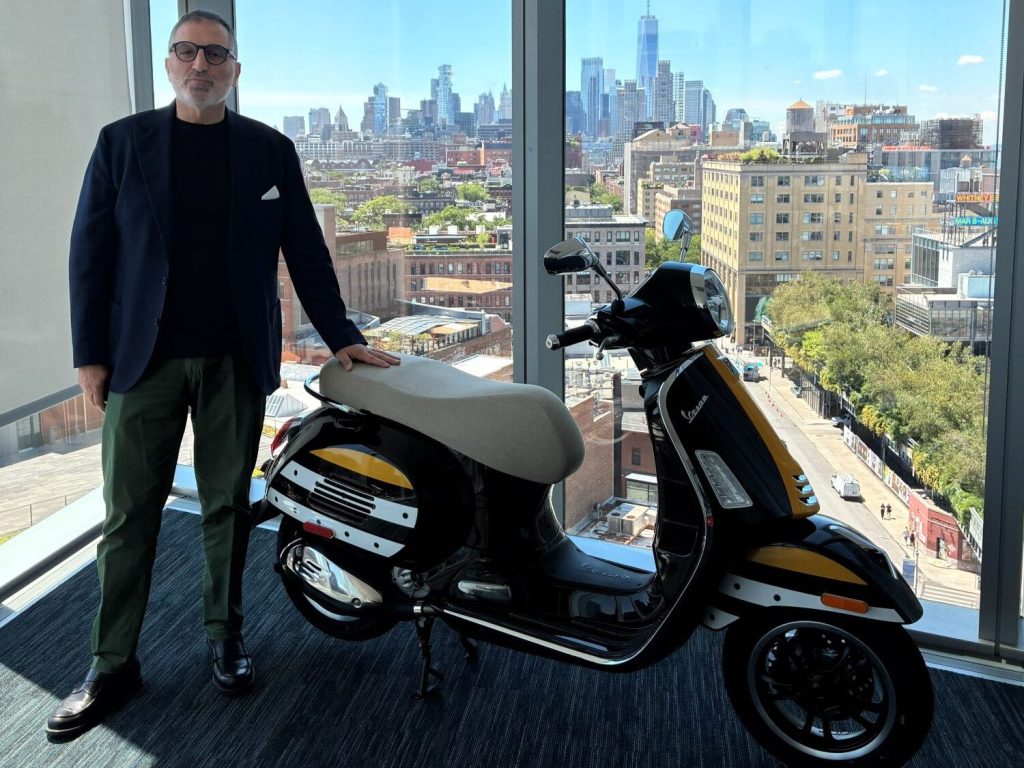
On board Nave Amerigo Vespucci, during his stop in New York, there was also an event signed Vespa, a meeting between two symbols of Made in Italy, the ship school of the Navy and the most famous scooter in the world. From here we started for a conversation with Andrea Gucciardi, president and managing director of Piaggio Group Americas, the branch that brings beyond ocean the brands Piaggio, Vespa, Aprilia and Moto Guzzi, on the future of the group in the United States.
Leading Piaggio Group Americas is a manager who grew up in the world of engines and passionately before he was a leader. Gucciardi told us his idea of business, the value of representing Italian excellence in New York and the strategy with which Piaggio looks to the next years on the US market.
Let’s go to you. What was the path that led you to lead Piaggio Group Americas and what were the decisive moments of your career?
I spent my entire career in an industry of which I am first of all a great fan, working both in the four and in the two wheels. And I was lucky to live it on both sides, on the side of the manufacturer, then the wholesale, and on the retail side. There are two things that have always guided my way of working, customer and processes. I deeply believe that a company, in order to function and grow, must have clear, solid and measurable processes, but at the same time I believe that we cannot build an effective process without looking at it from the perspective of the customer. The question I often ask my teams is very simple, when you go to buy a product you really love, how would you like to be treated? That is the experience you have to offer to your customers. A decisive moment for me was when I drove BMW’s retail branch in Rome. I moved my office from the back office directly to the showroom, to a glazed office from which I saw customers enter and I could talk to them. That’s where I realized even more that you can’t manage a business by being closed behind a desk, you have to go out, stay in the field, among people. I think it’s the only way to really understand the market and succeed. Every time I had the recordings of customer satisfaction interviews, I always spent at least two hours a week listening directly to them, and I asked my teams to do the same. Listening to the customer’s voice you understand where you’re wrong and what you need to change, but also what you’re doing well and how you can maximize it.
What responsibility do you feel in representing a group symbol of Made in Italy in the United States?
It is first of all a great reason for pride. Representing an Italian group in the United States gives me the opportunity to be, somehow, an amplifier of culture, passion and Italian spirit in a market where Made in Italy is recognized as an excellence and has an extraordinary value. It is a message I try to transmit to our network. When I talk to dealers, I always remind them that we are not simply selling a product, we represent an Italian excellence and we operate in the high and premium range of the market. This spirit is already very present in our network, but my role is also to emphasize it and make it even stronger. For me, therefore, to represent Made in Italy is certainly a responsibility, but above all a huge plus, and I try to exploit to the maximum strength, transforming the values and culture that we represent in a concrete element of our communication and our positioning on the market.
Piaggio is a group with very different brands and a long tradition. What is your vision for Piaggio Group Americas over the next five years?
My vision for the next five years starts with a very simple goal, being closer to the customer. We are a mainly commercial organization and our role is to bring our brands and products to the market, building the best possible experience for the customer. When I arrived in the United States last year, one of the first things I noticed is that our network was not sufficiently capillary, and in our industry proximity to the customer is fundamental. If you buy a motorcycle or scooter and then you have to travel hundreds of miles to find a dealer or do a service, you are not offering a positive experience, you are creating a problem to the customer. This is why we are investing in the sustainable development of our network and, in parallel, in the after-sales, which we have strengthened not only in the United States but also in Latin America, where we have introduced dedicated resources that previously did not exist. The third element is training. I believe in the training of people working in our dealers, and we are working to use digital technologies and artificial intelligence to develop new training paths for the network. Because, in the end, we do not speak directly with the customer every day, we speak mainly through our dealers. My vision is to build a more capillary network, more prepared and able to offer an ever better experience.
In recent years you have invested to strengthen the presence of Piaggio in the United States. What results make you more proud and what are the main challenges that remain open?
Starting from the central role of dealers, one of the most proud results is the change in the quality of the relationship with our network. We want dealers satisfied, profitable and able to convey to customers the values and passion of our brands, and I believe that the best way to build this kind of relationship is to talk to them and, above all, listen to them. For this reason, in the last year, we have greatly intensified the moments of contact with the network. In Anaheim, during AIMExpo, I met personally about fifty dealers in three days, devoting them real time in one-to-one meetings. Then the COTA, the product training in Sardinia, the eighth anniversary of Vespa in Rome and, in the coming months, the great event Moto Guzzi in Mandello del Lario and EICMA. They are very different moments, but they all have a common goal, increase engagement, share the vision of our brands and build a stronger relationship with dealers. Because if the network understands and embraces the vision of the brand, then you can succeed. The results are coming, we are increasing the capillarity of the network and improving the quality of the relationship with the dealers, and this results in a better experience for the customer and, until today, also in an increase of our sales and our market share. Of course many challenges remain, and there are external factors, from the market to duties, which we cannot control. My approach is simple, focusing energies on what I can control and try to have the maximum impact on what I can affect. The rest must be able to adapt quickly.
Are there any new projects, investments or initiatives you are focusing on particularly in the United States and that, according to you, will be decisive for the future of Piaggio Group Americas?
I see three great directors, three of our brands. The first is Vespa. We have already begun a journey of evolution and repositioning of the brand, going more and more beyond the concept of simple mobility. Vespa is style, elegance, Italian culture, and we want to further strengthen its position as a premium brand, bringing it closer to the world of fashion and lifestyle. It’s a path we’re investing a lot in the United States. And we also have some surprises in store. In New York, for example, towards the end of 2027 we will have to change our offices, and I would like our new house not simply an office on the ninth floor, but something that physically brings us closer to our customers. For the moment, however, I cannot say much more. The second director is Aprilia. The results we are getting in MotoGP, the result of an important investment by the Group, are giving an extraordinary energy to the brand and are also translating into a strong commercial momentum. In the United States we want to consolidate and accelerate this growth, further strengthening the sports position of Aprilia. And then there is Moto Guzzi, a brand on which I believe there is a huge potential for the American market. The Group has invested a lot in the renewal of the historic Mandello del Lario plant. It is not simply a new factory, with very high levels of digitization, robotics and new technologies, we want it to become a real customer experience center, a place where the customer can understand and live the heart that beats in Moto Guzzi. The new museum, the history of the brand and the experience of Mandello represent something that very few manufacturers in the world can offer. And from Mandello there will also come new Moto Guzzi models, starting next year, on which we have great expectations for the American market. If I had to synthesize, Vespa’s evolution towards an ever more space linked to style, elegance and lifestyle, consolidation of Aprilia as a great sports brand, also through the strength of MotoGP, and a strong revival of Moto Guzzi, starting from Mandello, its history and the new products that will arrive. Three different brands, three different strategies, but all with enormous potential in the United States.
L’articolo Andrea Gucciardi and Piaggio Group Americas, the Made in Italy and the sweet life on two wheels proviene da IlNewyorkese.
