
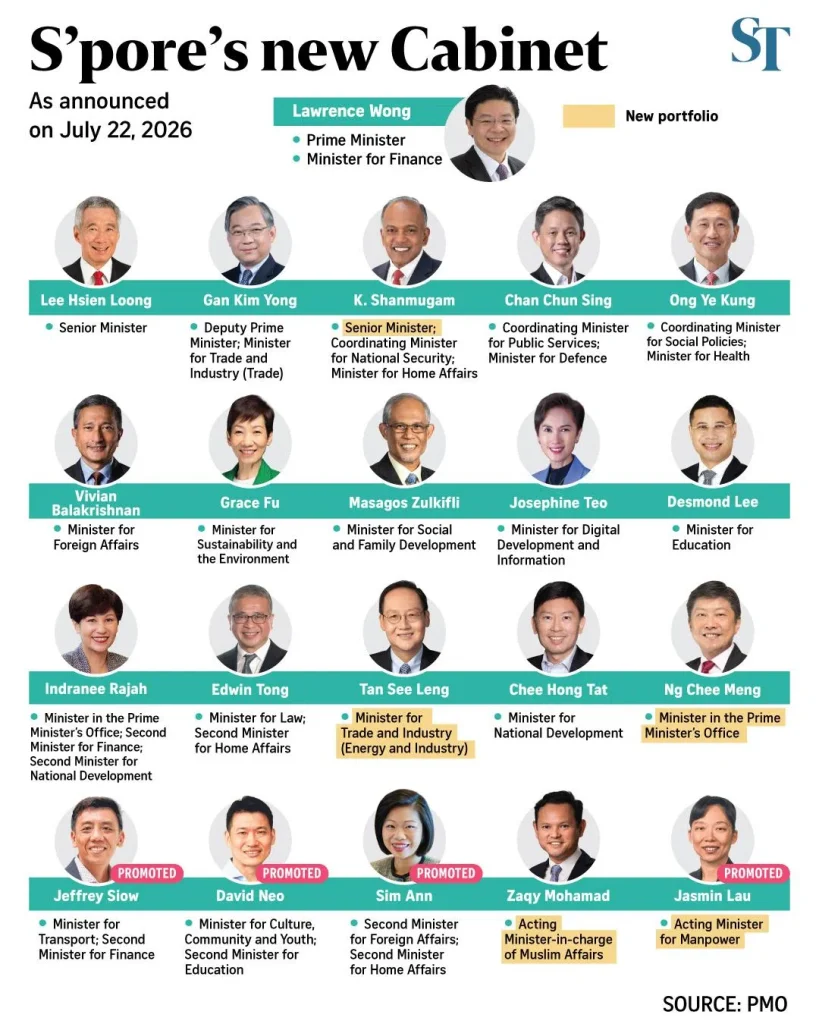
SINGAPORE – The recent promotions of newer and younger political office holders point to an emerging fifth-generation leadership team, even as the fourth-generation team consolidates its position for the long run, said analysts about the latest Cabinet changes.
Announced on July 22, the reshuffle sees four new faces from the 2025 general election promoted, and another two first-term backbench MPs appointed as office-holders. This gives younger ministers a longer runway and broadens the pipeline at the junior levels, they said.
The analysts also noted that veteran ministers continue to helm key portfolios, balancing leadership renewal with continuity.
“This reshuffle is about consolidation of the existing leadership team but, more importantly, the accent is on leadership renewal,” said Singapore Management University Law Professor Eugene Tan.
Prime Minister Lawrence Wong is also signalling that the pace of renewal must quicken, he added.
From the new batch of PAP MPs from the 2025 General Election, backbenchers Foo Cexiang and Shawn Loh will join political office as ministers of state, while Jasmin Lau will be promoted to Acting Minister for Manpower and Goh Pei Ming will move up a level to senior minister of state.
Jeffrey Siow and David Neo will become full ministers after spending over a year as acting ministers. They will remain in their current ministries.
Independent political observer Felix Tan said the growing level of responsibilities taken on by the new faces is a signal of confidence from PM Wong in their abilities, “by giving them the time, exposure, and opportunities to grow into their roles”.
“Leadership renewal isn’t just about bringing in new people; it’s about investing in them and allowing them to develop into the next generation of political leaders,” Tan added.
IPS Social Lab senior research fellow Teo Kay Key said members of the 2025 cohort have been moved into leadership positions, likely with an eye to forming the 5G leadership bench in advance.
She noted that with the departure of several veterans, including those who retired before GE2025, the pool of experienced office holders has shrunk. There is a need to ensure renewal continues, and that newer political office holders gain more experience faster.
Lau’s appointment as Acting Manpower Minister alongside her promotion to Senior Minister of State in the Ministry of Digital Development and Information indicates confidence in the work she has done, Teo said.
“In this period where there is a lot of anxiety over people’s livelihoods and jobs, this is a posting that will require her to step up to the challenge,” Teo added.
She said allowing the newer batches of MPs to experience a fuller slate of portfolios at an earlier time will likely give them “a longer runway to develop their abilities, discover their strengths, and also provide them a more multifaceted perspective when making policies whichever ministry they end up in”.
Former PAP MP Inderjit Singh said he was not surprised to see many young MPs being promoted in PM Wong’s latest Cabinet reshuffle as it is “better to test them early”.
“PM is accelerating the formation of his full 4G team, but also starting to think of the 5G team,” Inderjit added.
Even as he speeds up political renewal, PM Wong has made sure there are still experienced hands around to helm key portfolios, the analysts said.
While he has been made Senior Minister, K Shanmugam continues as Coordinating Minister for National Security and Minister for Home Affairs. Meanwhile, Deputy Prime Minister Gan Kim Yong helms the Trade and Industry portfolio and Vivian Balakrishnan helms the Foreign Affairs portfolio.
Commenting on this, the analysts said keeping experienced hands on deck ensures continuity, especially as the external environment becomes more volatile.
SMU’s Tan said Shanmugam being made Senior Minister is recognition of his significant role in Government, adding that he continues to be an important mentor to his younger colleagues and is also an “activist” within Government – relooking laws, policies, approaches to governance.
Singh said that as Senior Minister, Shanmugam can still play an important role supporting PM Wong, and will also bring stability.
Commenting on the 3G and 4G leaders helming key portfolios, Nydia Ngiow, managing director at strategic advisory firm BowerGroupAsia Singapore, said: “This shows how the two dynamics can coexist with institutional weight at the very top, but genuine entrenchment for 4G in other increasingly critical portfolios.”
IPS Social Lab adjunct principal research fellow Tan Ern Ser said this also means a longer runway for the younger ministers to gain the experience they need to form the next generation of core ministers.
Singh noted that in some cases, younger ministers in the 4G team were only appointed to minister or acting minister roles just a year ago.
“It will be too risky to retire the older ministers without sufficiently testing the new ministers, so it is not a surprise,” he added.
Retaining the older ministers also reflects Singapore’s historical approach of a “stretched timeline” for political transitions, he said.
PM Wong, when asked during the press conference, had said Singapore needs both experienced leaders to steer the country through immediate challenges, and a new generation ready to take it forward.
Acknowledging this, SMU’s Tan said the reshuffle is about consolidation.
He added that the fact that PM Wong has opted not to make too many changes at the top raises the question of when 4G leaders would helm certain key ministries. While there are 4G and 5G political office-holders at these ministries, that is quite different from helming them, he said.
