
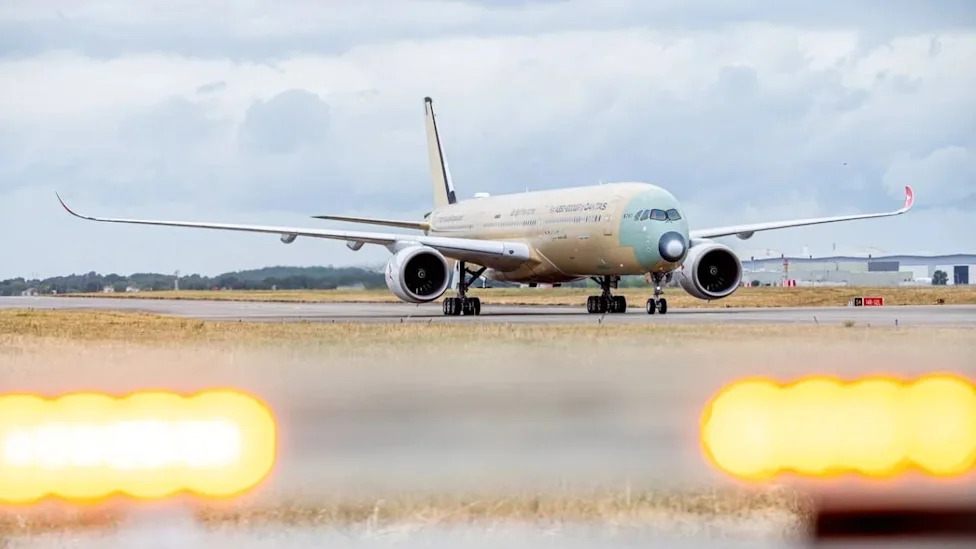
An Airbus A350-1000ULR has become the most tracked flight in the world, as the European airliner has made its way down towards Australia on a test flight. It took off from its birthplace of Toulouse, France, for a flight that was scheduled to take 19 hours.
That in itself doesn’t sound particularly extraordinary. Aircraft fly from France, Britain, Germany or other countries to Australia all the time. The difference here, though, is that this Airbus is testing out whether it is possible to do the whole flight in one go with a direct flight.
That’s right. Airbus, together with Qantas, has been working on what it has called ‘Project Sunrise.’ The aim is to remove the need for layovers and connections, allowing those onboard to sit back and fly all the way to their destination without having to worry about swapping planes at another airport.
Advertisement
Advertisement
The test Airbus A350-1000ULR took off from France on July 23rd at 7:33 am local time, before it touched down in Melbourne after a flight of 19 hours and 13 minutes. According to Qantas, four Airbus flight test pilots and five flight test engineers were onboard the aircraft.
Why Airbus and Qantas Conducted the Test Flight
The idea behind the test was simple. Qantas wanted a new ultra-long-distance aircraft that could do a flight from London to Sydney, one of its direct routes, nonstop, which would be a total flight time of 22 hours. Airbus was commissioned to produce the A350-1000ULR, with the ULR naturally standing for ultra-long range.
In total, Qantas is looking to take delivery of 12 of these new aircraft. The first delivery is scheduled for April 2027, and the remaining 11 aircraft will follow over the course of two and a half years. The test flight attracted huge attention worldwide. More than 60,000 people followed its 17,000km journey on flight tracker Flightradar24, making it the most-watched flight globally on Friday. The Airbus landed in Melbourne on July 24th at 10:46 am local time.
Qantas said that the aircraft will stay in Melbourne over the weekend before it departs for Toulouse on Monday for another non-stop flight. This flight would take longer, 23 hours, with the crew testing systems from fuel transfer to air conditioning as they fly back. That is nearly an entire day in the skies. The potential of a non-stop, 22-hour flight does, however, mean passengers will have to stretch their legs a bit more on the aircraft.
Where the Project Sunrise Name Came From
It is interesting to note where the project got its name from, but it carries some historical significance. In the Second World War, after Singapore fell, Qantas operated Catalina flying boats from Western Australia to Sri Lanka. This allowed them to connect with onward flights to London. These non-stop flights carried just three passengers and up to 70kg of mail, and lasted 33 hours. That allowed passengers and crew to see the sun rise twice.
Advertisement
Advertisement
It is these flights that gave the new Airbus its unique name. To increase the range, Airbus added a new rear centre tank to the jet, increasing fuel capacity by a huge 20,000 litres. The jet also has an increased take-off weight, and the airspace within the cabin has been optimized for longer-haul flights. Powering the new airliner are two Rolls-Royce Trent XWB-97 engines. The prototype is currently undergoing a two-month flight test programme to ensure it is fit for service.
If you want more stories like this, follow Guessing Headlights on Yahoo so you don’t miss what’s coming next.
