
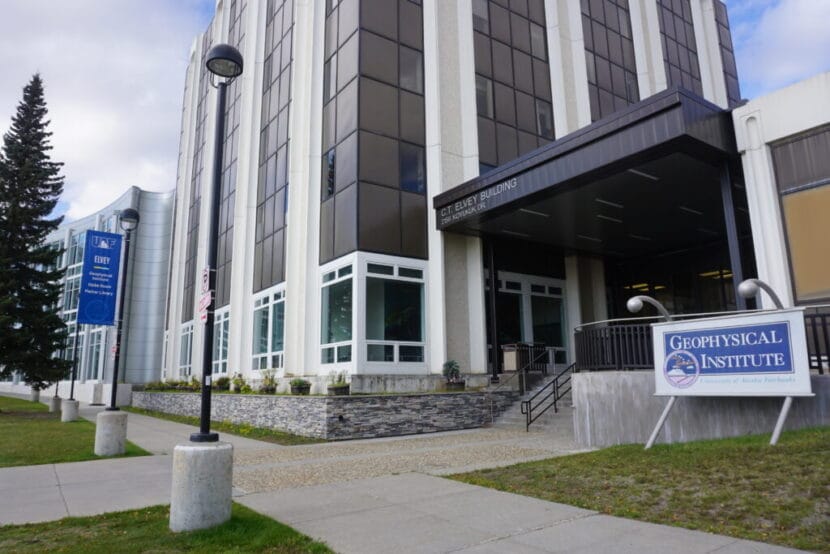
The Geophysical Institute at the University of Alaska Fairbanks is seen on Sept. 18, 2022. The National Science Foundation announced the establishment of a new critical minerals program to be led by and located at the UAF facility. (Yereth Rosen/Alaska Beacon)
The National Science Foundation has selected the University of Alaska Fairbanks to be the site of a new critical minerals research program, making it one of 12 new technology innovation centers across the nation that received federal funding.
The new Critical Minerals Accelerator Engine in Alaska will receive $15 million in funding for two years and up to $160 million over 10 years, the university said on Tuesday.
The organization will be located at and led by UAF’s Geophysical Institute and will work with more than 40 partners, said Steve Masterman, the university faculty member who helped lead the application for the award. Partners include private companies, Native corporations, nonprofits, other universities and other entities, said Masterman, who formerly served as Alaska’s state geologist.
UAF already conducts scientific research into minerals considered critical to the nation’s economy through its Critical Minerals Collaborative. That program is more scientific and academic-focused, said Masterman, who is its deputy director.
In contrast, the Critical Minerals Accelerator Engine will be focused on putting research to use, determining ways to commercialize resources, addressing supply needs, workforce development and other issues important to the critical minerals industry.
Though the scientific research already conducted at UAF will be helpful, the accelerator idea is industry-focused, Masterman said.
“This is quite different because it’s an economic development project,” he said.
Alaska is rich in resources considered critical minerals. The state has 56 of the 60 minerals classified by the U.S. Geological Survey as critical to the nation’s economy, UAF said in its statement.
In addition to the Alaska award, the NSF on Tuesday announced its awards for other innovation engines in different parts of the nation. The sites have different primary purposes, such as disaster prevention and mitigation, robotics development and development of advanced information technologies.
The Alaska innovation engine will be led by Lee Ann Munk, a faculty member at the Geophysical Institute and a geosciences professor at UAF’s College of Natural Science and Mathematics. Munk is currently director of the Critical Minerals Collaborative at UAF.
“Our NSF Engine is built on the simple but ambitious idea that Alaska can lead the nation not only with the abundance of its critical mineral resources, but also in how we innovate, develop and deploy the technologies needed to produce them responsibly,” Munk said in a statement released by the university.
“By bringing together researchers, Alaska Native organizations, industry, workforce partners, state and federal agencies, national laboratories and communities, we are creating an engine that accelerates discovery into action,” she said.
