
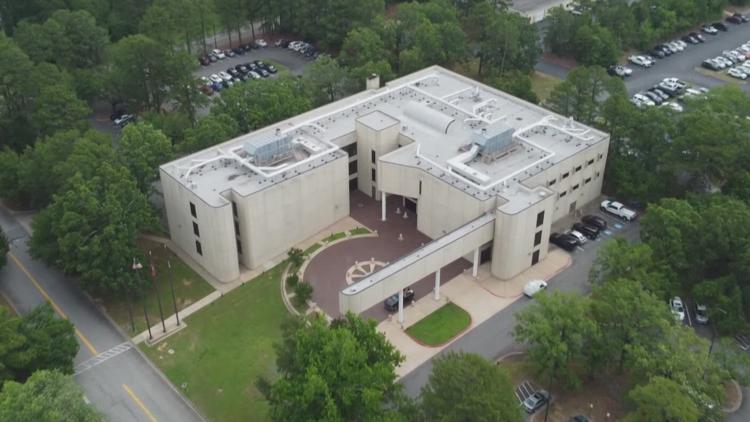
The Arkansas State Crime Lab’s load grows as case backlogs slow vital DNA testing, prompting agencies to seek private labs and fund a new facility.
LITTLE ROCK, Ark. — Inside Arkansas’ state crime laboratory, scientists work daily to turn evidence into answers. Their work supports investigations across the state, but for many agencies, those answers are taking longer than they’d like.
Officials say the Arkansas State Crime Laboratory plays a critical role in the justice system, processing evidence that can determine the outcome of criminal cases.
“We have an incredible team at the Arkansas State crime laboratory that is committed to performing excellent forensic science work every single day that really impacts so many people throughout the state of Arkansas,” Theodore Brown, the Arkansas Crime Lab Director and Chief Medical Examiner, said.
That impact is massive because Arkansas operates with only one central crime lab handling evidence from across the entire state.
“One thing about only having one crime laboratory in the state is we do have all of the cases,” Sammy Williams, Arkansas Crime Lab Deputy Director, added.
That reality creates a growing challenge, a backlog. Cases are piling up, especially complex ones like DNA tests, where results aren’t always immediate.
“There are also times that you may not get a DNA profile or a usable DNA profile the first time, and so our analysts are going to go back, look at the case, and see what else is there to test that could be helpful, and so that can add additional time,” said Jennifer Beaty West, the Arkansas Crime Lab Deputy Director of Scientific Operations.
Even under ideal conditions, DNA testing can take days. Additional analysis can extend that timeline further.
For law enforcement agencies, the delays can slow investigations and prolong closure for victims and their families.
“It’s a waiting game,” Benton Police Quinton Jackson said. “Because we never know, because it depends on where they’re at, what type of crime it is, what exactly we’re asking for. So, if it’s more complex, obviously it’s going to be longer.”
To keep cases moving, departments across Arkansas are adapting. Some agencies are expanding their in-house capacity for certain forensic work to reduce the burden on the state lab.
“Agencies have worked to be able to do more in-house, to help alleviate some of the things that we actually send to the state crime lab,” Officer Jackson said.
In some cases, investigators are also turning to private laboratories for assistance. Companies specializing in advanced DNA analysis can provide additional options when traditional methods do not yield results.
“If it doesn’t get an identity from there, then it can be flipped over to OTHRAM, and we could do our advanced DNA testing,” said Michael Vogen, OTHRAM Director of Law Enforcement Solutions.
These private labs use forensic genealogy, analyzing hundreds of thousands of DNA markers far beyond traditional testing methods to help identify suspects or victims. However, Vogen says funding remains a key obstacle.
“The only thing holding these cases up from being sorted out, many times, many instances, is funding. Like, if we can redirect funding and make it a priority, Vogen said. “I think we would have a mass change in the number of cases that are, quote, unquote, cold or not being able to get resolved.”
While private labs can help, they are not a replacement for the state facility. Instead, Arkansas is investing in a long-term solution, a new, state-of-the-art crime laboratory.
The state legislature has allocated $200 million for the project, which aims to address one of the lab’s biggest current limitations — space.
“Our hands are tied on being able to add additional staffing or add that additional instrumentation to improve capacity,” Beaty West said.
The new facility is expected to more than double the lab’s capabilities, improving efficiency, reducing turnaround times, and expanding access to new technology.
“This new building, this new state-of-the-art building, will increase our capacity to do forensic case work,” Brown said. “It will allow us to be future-ready, meaning that we can grow and expand as we know that the volume of cases will increase over the next three to four to five decades.”
Among the advancements planned is rapid DNA testing, which could deliver results in as little as 90 minutes.
“You can input a DNA sample with the expectation of getting a result within 90 minutes, which is phenomenal,” Beaty West said.
And for the first time, all forensic disciplines will be fully integrated under one roof, each in its designated area.
“So those teams can collaborate with each other if a piece of evidence needs to be worked by multiple sections, those sections can move that evidence very quickly to each other without it having to be driven, you know, hours away to some other laboratory,” Williams said.
For investigators, that could mean faster answers. For families, it could mean quicker closure.
The post Backlog at Arkansas Crime Lab delays cases as state plans $200M upgraded facility appeared first on World Online.
