
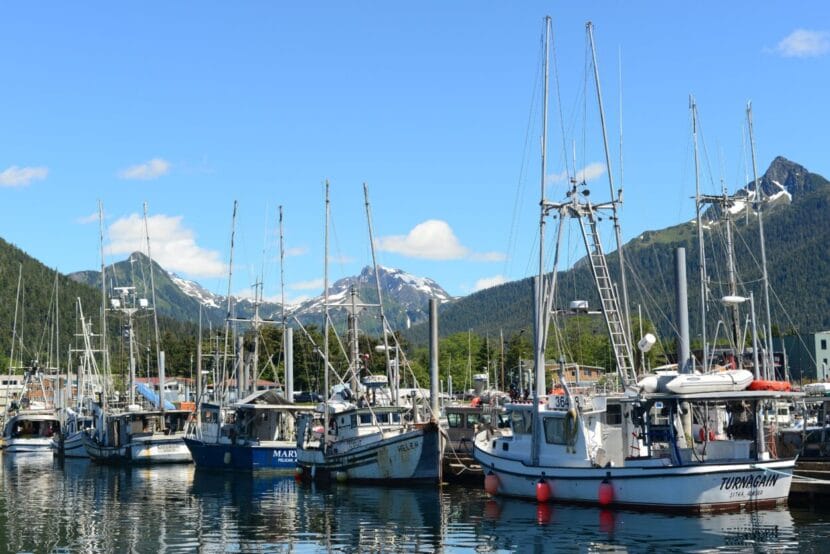
Trollers moored in Sitka’s Crescent Harbor. (Berett Wilber/KCAW)
Southeast Alaska’s commercial king salmon fishery will remain open until further notice. The July 1 king opener for trollers, who fish with hook and line, is usually over quickly– it typically lasts anywhere from a handful of days to a week. But this year, with two weeks down, trollers are only at the halfway mark toward catching their target.
Grant Hagerman is the Southeast region’s commercial troll management biologist with the Alaska Department of Fish and Game. In an interview with KCAW on July 13, Hagerman said in the past two weeks, trollers have caught roughly half of the 84,000 allotted Chinook salmon.
“Fishing is a little bit slower, definitely,” Hagerman said. “But we have fewer boats. There’s less effort this year as well. So a combination of those two has has prolonged this longer than what we’d anticipated, preseason.”
Hagerman said about 400 permit holders have participated in the king salmon fishery so far this year, compared close to 470 last year. He said with the current fleet size it could take up to two more weeks to catch the remaining kings, extending an already unusually long opener. But fishery managers are taking things day-by-day, and Hagerman said that projection could change, especially if other fisheries slow down.
“There’s roughly 80 to 90 [trollers] that are down in West Behm Canal and in Neets Bay Terminal Harvest area that are targeting chum salmon,” Hagerman says. “If that should, you know, drop off, we may get more of those vessels back out targeting king salmon, which could speed things up.”
The price of chum salmon is up again this year. While chum salmon are less valuable than king salmon, per-pound, the chum fishery can target far more salmon, and Hagerman said the chum in Neets Bay are actually bigger than Chinook.
Prices are up for troll-caught king salmon too. Hagerman said it’s the highest July price for the fish that he can recall at just over $9 dollars a pound.
“Preseason we were kind of anticipating that that might draw more vessels out for for fishing, but [that’s] just not the case. You know fuel prices are still fairly high,” he said. “If the boats aren’t out doing as well as they need to and they’re burning fuel, then they may choose to do something else, either tie off at the dock, or go try chum salmon, which has been pretty successful so far.”
The number of kings Alaska trollers can catch is determined by the Pacific Salmon Treaty, an agreement between the US and Canada that governs the harvest.
Hagerman says the July fishery will remain open until further notice, and the state department will try to give the fleet as much notice as possible before they implement a closure. The fishery will open for a second time in August for trollers to target the remaining treaty kings.
