
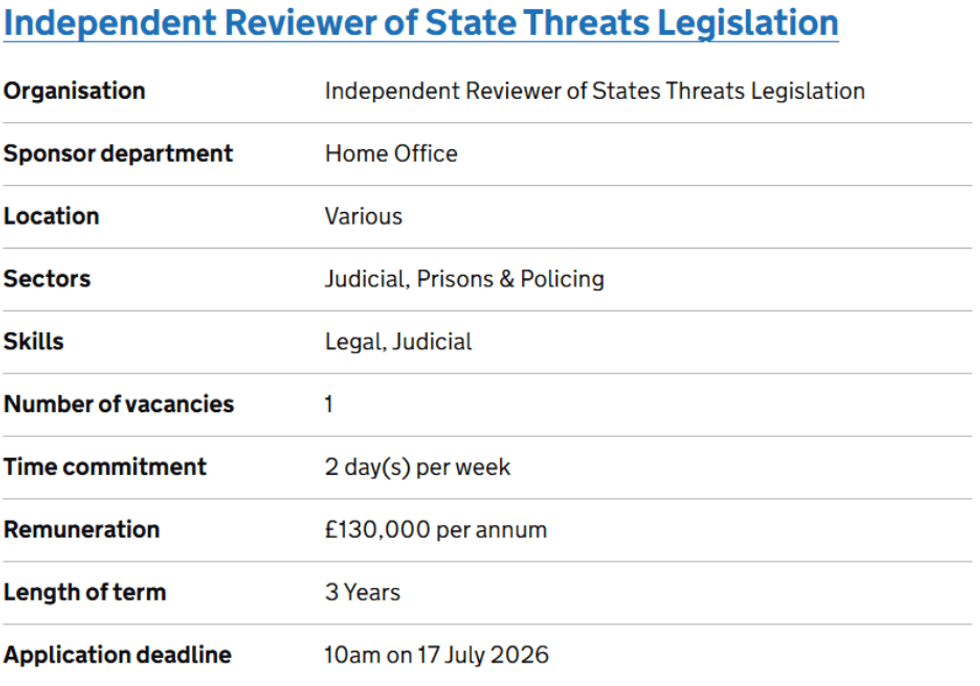
Shabana Mahmood is seeking to appoint a new Independent Reviewer of State Threats, a role advertised as requiring two days of work per week, a move critics warn is “sending the wrong signal to hostile states”.
In May, the Joint Terrorism Analysis Centre (JTAC) raised the UK’s National Threat Level from substantial to severe, meaning a terrorist attack is considered likely. At the same time, high numbers of illegal small boat crossings have continued, prompting one expert to accuse the government of trying to solve a “five-day problem” with a “two-day answer.”
The successful applicant would review the effectiveness of legislation designed to combat hostile state activity, including sabotage and foreign interference, before reporting their findings to the Home Secretary.
The Home Office-sponsored role pays £1,250 per day. Based on the advertised commitment of two days per week, the position would pay around £130,000-a-year – more than three times the UK’s average annual salary of £39,000. Over the three-year term, the successful applicant could earn almost £400,000.
Responding to the job advert, former Superintendent and Counter Terrorism Adviser for Police Scotland, Martin Gallagher, said: “This is not a period in history for part-timers. This is a moment for dedicated professionals to bring their full attention to bear in countering the new threats we face. If we don’t take these threats more seriously, we will all suffer.”
Mr Gallagher added: “Legislation needs to be monitored and developed as the actions of those intent on harming us become clearer.”
Mr Gallagher concluded: “My expert opinion is that this should be a full-time role.”
Terrorism and security expert Roger MacMillan also criticised the government, arguing that the appointment was “sending the wrong signal to hostile states” and questioning why ministers were not “serious about state threats.”
The job advert specifies two days a week
|
GOV.UK
He told GB News: “This role sits at the centre of the UK’s response to sabotage, espionage and foreign interference. Treating it as a part-time role sends exactly the wrong signal to hostile states watching how seriously we take this.
“A severe threat level deserves more than a part-time reviewer. This is a five-day problem being given a two-day answer.”
The Independent Reviewer’s role is intended to inform public and political debate on the UK’s anti-terrorism laws. It carries several statutory responsibilities, including conducting annual reviews of the Terrorism Act 2000 and Part 1 of the Terrorism Act 2006, covering powers such as stop and search, arrest, and detention.
Responding to the findings, William Yarwood, Campaigns Director of the TaxPayers’ Alliance, said: “Paying someone nearly £400,000 to review terror laws while asking them to work just two days a week sends an extraordinary message about the Government’s priorities.”
The Government insists the role is not part-time
|
GETTYMr Yarwood added: “Either this role is vital to national security and deserves full-time attention, or ministers are handing out another gold-plated part-time public appointment.”
Mr Yarwood continued: “Taxpayers deserve both serious scrutiny of terrorism legislation and proof that this eye-watering salary represents value for money.”
In addition to the annual statutory reviews, the Independent Reviewer may be asked to produce one-off reports for ministers or Parliament on specific issues, such as Jonathan Hall’s report on terrorism in prisons.
The reviewer is also required to give written and oral evidence when called upon by parliamentary committees, including the Home Affairs Select Committee and the Joint Committee on Human Rights.
A Home Office spokesperson said: “This government takes state threats legislation extremely seriously, which is why we will appoint a leading authority on state threats to conduct an annual review and report directly to the Home Secretary.
“This is not a part-time job and is the same model used for many independent review roles. The Independent Reviewer’s duties are set out in law, and they are expected to carry out whatever work is necessary to meet them.”
