
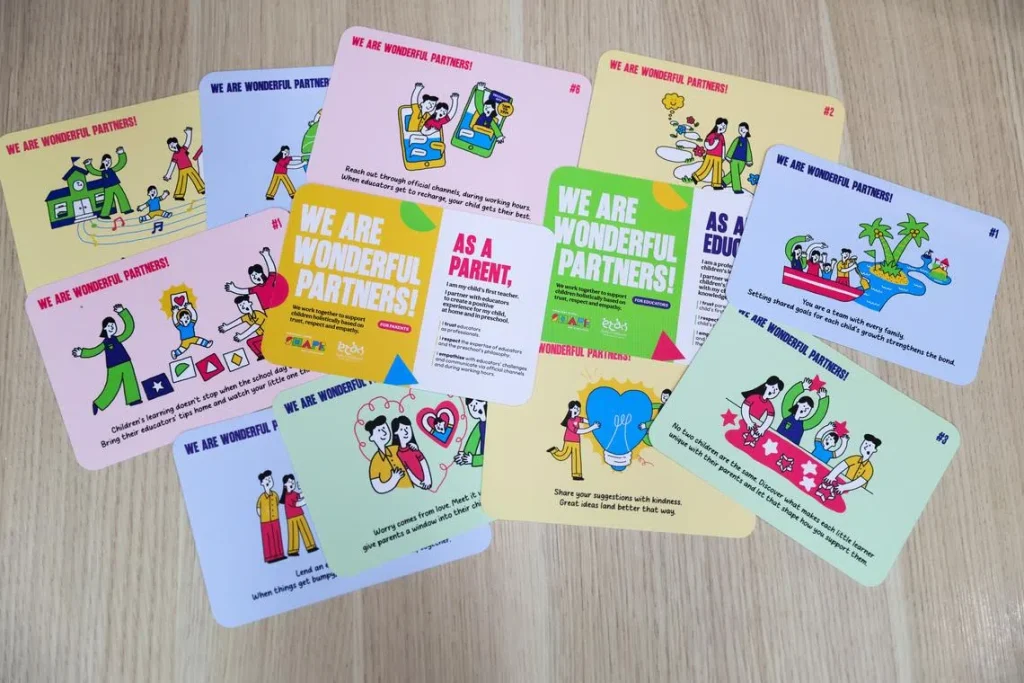
SINGAPORE – A new guide has been launched to help parents and early childhood educators work together and to address challenges in their relationship.
The resource, which is developed together with parents, educators, pre-school operators and sector partners, contains guidelines for various stakeholders to understand their roles in giving children a positive start.
It seeks to strengthen collaboration between parents and educators “to support continuity in learning, consistency of care and positive development outcomes in the early years”, said the Early Childhood Development Agency (ECDA) in a statement.
The guide titled We Are Wonderful Partners! was launched on July 18 at Our Wonderful Parents Learn & Connect, an event at Safra Toa Payoh organised by educational consultancy Preschool Market and supported by ECDA.
Speaking at the event, Minister of State for Social and Family Development Goh Pei Ming said children will have a more conducive environment to grow up and thrive when the adults at home and in school are aligned.
Recounting his experience, Goh said he allowed his youngest daughter in K2 to exercise more initiative at home after he learnt from her teacher that she had exhibited leadership qualities, including helping her peers at pre-school.
“I’m sure, many parents who are here also have similar insights and moments like this – where one conversation with our child’s teachers, educators, changes the way that you approach bringing up the child,” Goh said.
He said engagements and surveys done with parents and teachers have shown that parents want more clarity about their role in education. Meanwhile, educators indicated that they want to be seen not just as a service provider but as a partner.
He said the guide provides a practical way forward for parents and educators who want the best for the children.
ECDA said the resource is anchored on three core values that underpin effective parent-preschool partnerships, including trust from parents to recognise educators as professionals in child development, and educators acknowledging parents as a child’s first teacher.
The second value is respect, with parents valuing the educators’ expertise and the pre-school’s philosophy, while educators appreciate the parents’ perspectives and understanding of their child’s and family’s needs.
The third is empathy, with parents showing consideration for educators’ well-being by communicating through official channels during working hours, and educators being responsive and open to parents’ concerns.
The resource, which is developed together with parents, educators, pre-school operators and sector partners, contains guidelines for various stakeholders to understand their roles in giving children a positive start.
PHOTO: LIANHE ZAOBAO
The agency said previous consultations had revealed challenges in parent-pre-school partnerships, including how parents, the pre-schools and teachers can communicate sensitively with one another.
ECDA said the insights informed the guide’s emphasis on building a shared understanding of roles and responsibilities, and establishing a common language for partnership.
Physical copies of the guide will be distributed to about 1,800 pre-schools across Singapore, with digital versions made available to parents through the pre-schools’ communication channels.
This will be alongside ongoing community engagement activities including roving activations at selected pre-schools and events during Teachers’ Day celebrations in August.
Speaking to the media, Norizan Rahmat, 51, lead pre-school educator at the 7oaks Preschool at Jurong West Street 81, said she hopes the guide can allow parents to be more empathetic towards educators, while providing guidance to teachers on supporting parents with their needs.
Norizan Rahmat, lead pre-school educator at the 7oaks Preschool at Jurong West Street 81, said she hopes the guide can allow parents to be more empathetic towards educators.
PHOTO: LIANHE ZAOBAO
Norizan, who has 15 years of experience in the sector, said to build a relationship with parents, she finds the time to connect with them first before moving to other things like sharing about the developmental stages of the children.
“First and foremost, is to understand where the parents’ level of comfort is.”
Nithiyasri Subramaniam, 41, whose daughter attends PCF SparkleTots @ Bukit Timah Blk 305 has first-hand experience with the benefits of open communication.
Nithiyasri and her husband initially could not understand the homework their daughter brought back from her Mandarin lessons, as they do not speak the language.
Nithiyasri Subramaniam and her husband Daeshar reading the guide on July 18.
PHOTO: LIANHE ZAOBAO
The couple used translation apps at first, but after discussing the issue with the teacher, the school provided a translation of the homework in English.
Nithiyasri, who is a special education needs officer, said she and her husband speak to their daughter’s teachers when dropping by the school instead of just relying on official sessions like parent-teacher conferences.
She said it has proved useful in getting updates about her child.
“It’s a regular communication – and this really strengthens our partnership in school with the teachers,” she added.
