
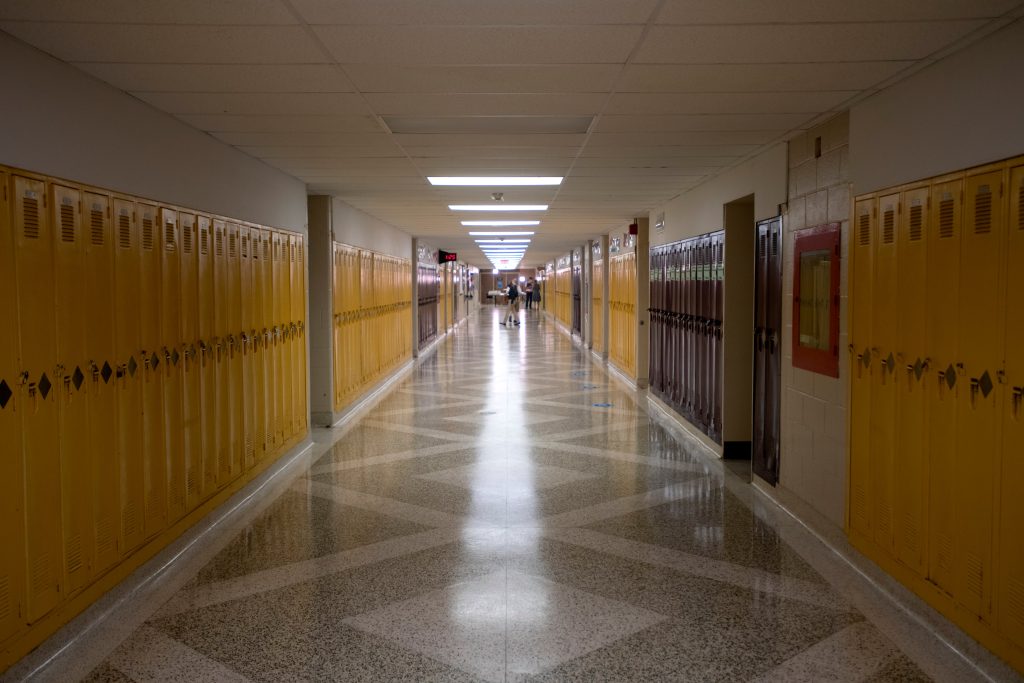
In Ontario, data provided by the government shows that about 40 per cent of high school students met attendance standards in the last school year, down 20 percentage points from pre-pandemic levels.Fred Lum/The Globe and Mail
Ontario’s plans to award high school students who attend class regularly with higher grades may incentivize some teenagers, but educators worry that it will do little to address the underlying issue of chronic absenteeism.
Education Minister Paul Calandra tabled sweeping legislation on Monday that would overhaul school board governance and change how classrooms are managed.
The proposed measures include a policy change which would make high school attendance count for a sizeable portion of a student’s final grade. More specifically, participation and attendance would count for 15 per cent of final marks for Grades 9 and 10, and 10 per cent in Grades 11 and 12. Currently, attendance does not factor into grades.
Under the proposal, students would not be penalized for excused absences, including religious holidays and illnesses.
Written exams would also be mandatory under the legislation. Some educators have moved away from final exams into more cumulative assessments.
Parents, are your children affected by the new school attendance rules in Ontario? Let us know
The measure to link attendance with final marks has sparked widespread discussion among educators and families about whether it’s the best way to support students. Research has shown that attending class regularly is one of the biggest predictors of academic achievement. The chances of graduating high school and going on to postsecondary diminish for students who have missed more than 10 per cent of a school year, which is considered chronic absenteeism.
In Ontario, data provided by the government shows that about 40 per cent of high school students met attendance standards in the last school year, down 20 percentage points from pre-pandemic levels. The percentage reflects students who attend at least 90 per cent of school days in any given year.
Ontario tables bill to change oversight of province’s education system
“There has to be consequences for not attending. There has to be consequences for bad behaviour. And I think over the last number of years, we’ve fallen away from that,” Mr. Calandra told reporters at Queen’s Park on Wednesday.
He said the policy would also take into account that some students are not regularly attending school for a host of reasons, including disabilities or mental health issues, and indicated that teachers will have some discretion into the participation mark.
“The regulations that we put in place will respect the fact that there are many challenges that people will face, and they shouldn’t be penalized for those,” he said.
“A student should be in school. If you can be there, you should be in class. You should be learning. You should be participating.”
One education researcher cautioned that attendance measures are inconsistent with the evidence on how to support student learning. Kelly Gallagher-Mackay, an associate professor at Wilfrid Laurier University who focuses on education policy research, said more thoughtful, targeted interventions, including academic and social supports for students who are struggling and don’t attend school have been shown to be more effective.
Chronic absenteeism, she said, is often tied to other issues, including health and social challenges. “What you want is students to realize they want to be there because they’re learning, not because of a transactional reward system,” she said.
Why is the Ontario government taking over the province’s biggest school boards?
Prof. Gallagher-Mackay acknowledged that attendance is an issue in schools. Her research has shown that as early as Grade 4 it can be a predictor of whether students participate at the postsecondary level.
“It’s a really big problem. I am completely convinced we need to address attendance. I’m just trying to say let’s try and not address it in a way that is harmful to vulnerable students,” she said.
In recent years, many school boards across the province have cut back on attendance counsellors to manage their budgets. They work with those at risk of dropping out and try and guide them back to the classroom.
Martha Hradowy, president of the Ontario Secondary School Teachers’ Federation, which represents 60,000 teachers and education workers, said her board in the Windsor area was among those that scaled back those positions. Other boards have also cut social worker positions, she said.
Ms. Hradowy said the data on student attendance is concerning. However, the government’s approach “misses the mark.”
“Students don’t disengage without reason. They disengage when they’re struggling, when they don’t feel supported or when a system isn’t meeting their needs,” she said.
“It [the student-attendance data] should be a wake-up call about the unmet student needs and not an excuse, in my opinion, to impose punitive measures.”
The post Ontario looks to incentivize high school attendance as numbers fall appeared first on World Online.

