
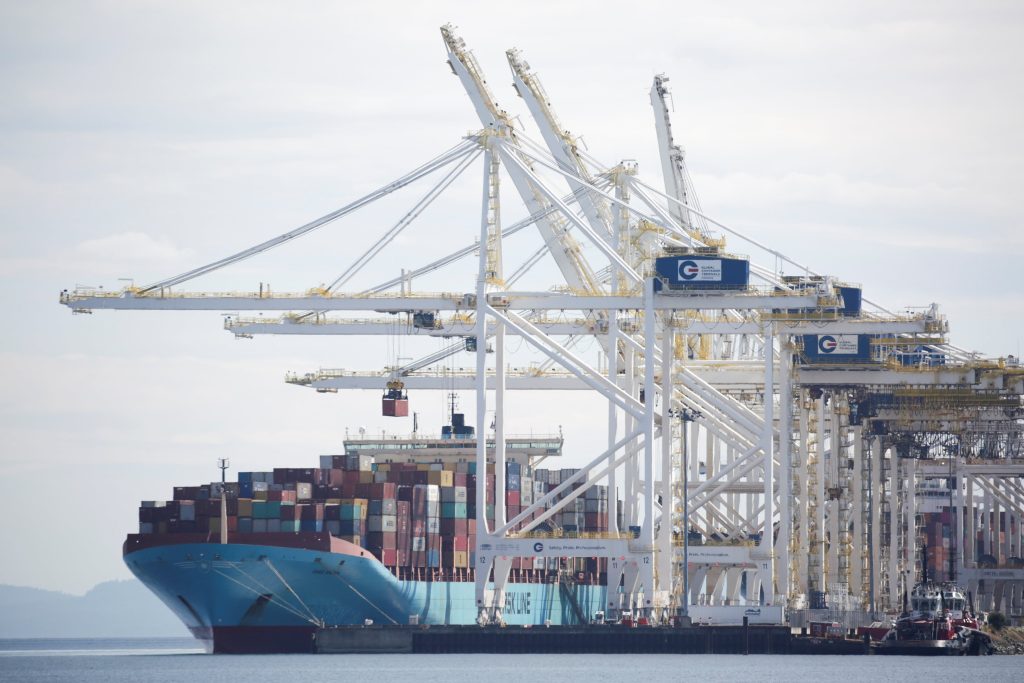
The ship Anna Maersk gets containers unloaded at Roberts Bank port, south of Vancouver, June, 2019.JASON REDMOND/Reuters
Vancouver’s port authority says it is going full steam ahead with the creation of an artificial island facility to load containers off Roberts Bank, south of the city.
But whether construction plans could soon include upgrading the facility to receive the world’s largest tankers to ship Alberta bitumen to Asian markets is not yet clear.
Prime Minister Mark Carney and Alberta Premier Danielle Smith announced an agreement on Thursday to develop a new pipeline to British Columbia’s south coast.
A map released by Alberta shows the proposed route following much of the existing Trans Mountain pipeline before splitting off in the Fraser Valley, east of Vancouver, to hug the United States border before ending at Roberts Bank.
Haley Hodgson, head of communications for the Vancouver Fraser Port Authority, said in a statement on Friday that the expansion of the RBT2 container terminal is totally separate from the proposed pipeline. The port authority is an arm’s-length federal agency that is in charge of the more than two dozen terminals in the region.
“The Port of Vancouver has not been involved in discussions regarding the pipeline route proposed by the Alberta government in its submission to the Major Projects Office,” her statement said.
“Alberta’s proposal is still at a conceptual stage and details regarding route and infrastructure have not been provided to us.”
Alberta’s summary of the proposal it submitted to the federal Major Projects Office estimates the entire export terminal would equal the size of about 485 NFL fields combined, with a tank farm of 15 containers that are able to store roughly 6.5 million barrels of oil.
Both the port authority that would oversee any eventual terminal and the nearby Tsawwassen First Nation say they do not know how a terminal and tank farm would fit in the area bordering the south arm of the Fraser River.
At a news conference earlier on Thursday with B.C. Premier David Eby, Mr. Carney told reporters that Ottawa will provide $10-billion to support the expansion. But he did not explain why the project received far more money than the port authority’s estimated cost of $3.5-billion.
Carney, Eby strike multibillion-dollar major projects deal ahead of West Coast pipeline announcement
In its proposal released this week, Alberta estimates the total costs of the pipeline to be between $35.2-billion to $43.7-billion, including contingency funds.
The Alberta Ministry of Energy and Minerals did not immediately respond on Friday to a request for comment on where and how the terminal would work in the waters near the existing Roberts Bank coal and container terminal. The Roberts Bank terminal is bordered by the Tsawwassen BC Ferries terminal to the east, and by tidal flats ending in the mouth of the Fraser on the other side.
Pierre Cuguen, a spokesperson with the federal Privy Council Office, said that “further details on the upgrades, roles, funding and next steps will be provided in due course.”
The Tsawwassen First Nation said it had not been consulted on the proposed southern pipeline route, which would terminate within its territory and potentially include a portion of Tsawwassen Treaty Settlement Lands under its jurisdiction.
Executive Councillor Valerie Cross said her nation has no position on the proposal yet.
“Now is the time for the proponents to reach out and connect with us to make sure that they honour our constitutionally protected treaty rights and we expect meaningful consultation,” she said in an interview.
The project is a major component of a push by the federal government to increase exports around the world in the face of a trade war with the United States, and make peace with Alberta over resource development ahead of that province’s upcoming referendum.
Kathryn Harrison, a political science professor at the University of British Columbia who researches pipeline politics, said Mr. Carney’s recent policies indicate he is pursuing a “very transactional federalism,” whereby deals are made province by province, often with billions of dollars of public money.
Critics have pointed out this week that many major federal announcements have been made without important details or information on how much Ottawa plans to spend annually on these various projects.
Alberta Premier Danielle Smith has pitched a new bitumen pipeline to the B.C. coast, just hours after Prime Minister Mark Carney announced a deal with B.C. to make it possible. Smith and Carney stood together in Calgary to announce that Alberta has formally submitted a proposed route to the federal major projects office. (July 2, 2026)
The Canadian Press
Dr. Harrison added that the failure over the past year to get the private sector to build this pipeline may stir up major opposition to the public project from taxpayers grappling with inflation and affordability woes.
Misty MacDuffee, a biologist and wild salmon program director with the Raincoast Conservation Foundation, said many of the neighbouring residents in Delta will likely oppose a massive tank farm in their community. She said they might also be against the risk of an oil spill in the Fraser River Estuary that could harm the various species it sustains.
Ms. MacDuffee’s organization often intervenes in projects and is one of the lead opponents of the container terminal expansion at Roberts Bank. She said any pipeline facility would need costly dredging of the foreshore to accommodate the Very Large Crude Carriers capable of transporting two million barrels of oil across the oceans.
She also said the existing shipping lanes are already threatening the resident killer whale population in the adjacent Salish Sea, which also sees marine traffic from other terminals in the region, including the Trans Mountain pipeline in the Burrard Inlet.
The noise from these massive vessels interferes with the ability of these mammals to echolocate their prey, she said.
On Thursday, Mr. Carney pledged to reload the federal funding of a program to protect Canada’s whales, but Ms. MacDuffee said bringing more oil tankers to these waters would be incredibly harmful.

